14 Disposable Email Checkers Tested: Which Are Better at Detecting Fake Signups?
Screening disposable email signups? There are tools for that.
But disposable email detection tools aren’t created equal. We ran an experiment comparing 14 of them, and we share the results here. Here’s a TL;DR version of the results in case you’re in a hurry.
| Rank | Checker | Detection rate | Disposable addresses missed (of 59) | False positives (of 6) |
| 1 | WhoisXML API Disposable Email Domains Database | 100% | 0 | 0 |
| 1 | UserCheck | 100% | 0 | 0 |
| 2 | TempMailDetector | 88.1% | 7 | 1 |
| 3 | EmailProbe | 86.4% | 8 | 1 (example.com) |
| 4 | Valid Email Checker | 84.7% | 9 | 0 |
| 4 | FFraud Database | 84.7% | 9 | 1 (example.com) |
| 4 | Reoon Email Verifier | 84.7% | 9 | 1 (example.com) |
| 5 | Disposable Database | 74.6% | 15 | 0 |
| 5 | Doodad-labs Disposable Email Domains | 74.6% | 15 | 1 (example.com) |
| 5 | Verifly Database | 74.6% | 15 | 1 (example.com) |
| 6 | SignupScore (formerly known as IsFakeMail) | 72.9% | 16 | 1 (example.com) |
| 7 | QuickEmailVerification | 67.8% | 16 (plus 3 errors) | 0 (plus 1 error) |
| 8 | ZeroBounce | 62.7% | 22 | 0 |
| 9 | Castle Disposable Email Domains | 50.8% | 29 | 0 |
How Disposable Email Detection Works
All disposable email detection tools answer the same question: Is this email address disposable? The difference is how they arrive at the answer, and these approaches are the most common, with many commercial tools combining two or more of these:
- Public blocklists: Community-maintained lists of disposable domains, often hosted on GitHub. They’re free and easy to connect to your codebase, but they only know about domains that somebody else has found and added to the list.
- Proprietary datasets: Vendors build and curate their own domain lists, which include data from public lists as well as from their own research and tools.
- Provider monitoring: Some vendors track disposable email services directly, generating addresses to collect the domains each service rotates through. Temporary mail providers add new domains all the time, so this approach helps catch what public lists miss.
- DNS, MX, and infrastructure analysis: Disposable domains often share mail servers, name servers, or hosting. Checking MX records and related infrastructure can flag a new domain even before it lands on any list.
What We Tested
We ran 14 disposable email checkers against email addresses from 21 disposable email providers. We picked both groups based on popularity — these tools have either been recommended by Reddit users or by ChatGPT, so these are the tools people are most likely to find when they search for the best disposable email detectors. Same for the disposable email generators — we picked the best-known or recommended ones — the ones that abusers are most likely to use.
The 21 Disposable Email Providers We Used
| Provider name | Brief description |
| Temp-Mail.org | Free disposable inbox with a changing pool of service domains and an official API |
| Mail.tm | Free temp mail with a public REST API that lists its active domains |
| Guerrilla Mail | Free inbox with no registration, several service domains, and a public JSON API |
| 10 Minute Mail | Free short-lived inbox that uses a small pool of domains that changes over time |
| YOPmail | Free inbox with no account required, on yopmail.com plus a new alternate domain each day |
| EmailOnDeck | Free inbox with no signup; API access is a paid Pro feature |
| Maildrop | Free public inbox with no signup, mainly on the maildrop.cc domain |
| Temp-Mail.gg | Free web service with multiple domains |
| MoeMail | Free mailboxes on multiple domains, with a REST API and webhooks |
| Temp1Mail | Free, unlimited addresses, mainly on the temp1mail.com domain |
| MailMomy | Free, unlimited addresses on multiple selectable domains |
| FreeCustom.Email | Free guest and account inboxes, with new domains added regularly |
| TemporaryMail.com | Free inbox with no account required and multiple selectable domains |
| IncognitoMail | Free, ad-free temp mail with service domains and custom domain support |
| Xeramail | Free disposable mailbox on domains such as phuturemail.com and xeramail.com |
| TrashMail | Email forwarding service with multiple domains; creating an address requires an account or browser extension. Since our test, trashmail.com has started redirecting to Aionda Mail, which offers disposable addresses under its own name. |
| NukeMail | Free temp mail with no signup; our addresses used gpxmail.win, zapmail.one, and dmail.one |
| Best Temp Mail | Free temp mail service; our addresses used aabkmail.com |
| CatchTempMail | Free temp mail service; our addresses used holdmytab.com and venturenodesystems.com |
| Temp Mail Plus | Temp mail app for Android, also available in the browser at temp-emails.net, which is the version we used |
| Mailinator | Public inbox service on mailinator.com plus alternate public domains |
The 14 Disposable Email Checkers We Tested
| Tool name | API or database | Coverage |
| WhoisXML API Disposable Email Domains Database | Database (commercial download) | 165,502 domains |
| UserCheck | API | Not published |
| TempMailDetector | API | Not published |
| FFraud Database | Database (GitHub) | 222,934 domains |
| Valid Email Checker | Database (GitHub) | 218,545 domains |
| Reoon Email Verifier | API | Not published |
| EmailProbe | API | 202,686+ domains (published by the vendor) |
| Doodad-labs Disposable Email Domains | Database (GitHub) | 278,567 domains |
| Verifly Database | Database (GitHub) | 181,767 domains |
| Disposable Database | Database (GitHub) | 97,298 domains |
| SignupScore (previously known as IsFakeMail) | API | Not published |
| QuickEmailVerification | API | Not published |
| ZeroBounce | API | Not published |
| Castle Disposable Email Domains | Database (GitHub) | 1,000 domains |
Database coverage is the number of domains in each list when we downloaded it, on October 13, 2026. Most API vendors don’t publish how many domains they cover.
Methodology: How We Conducted the Test
We tested 65 email addresses in total: 59 disposable and 6 non-disposable that we used to ensure that tools do not generate too many false positives. Originally, we had some privacy relays such as duck.com, but excluded them from the test upon further consideration, because it’s hard to definitely say what emails on these domains are. Here’s how we set the test up, using a combination of manual and automated processes.
Step #1: Collect Disposable Emails
We manually created email addresses on each of the 21 providers, aiming for three per provider and using different domains wherever the provider offered them.
Mailinator and TrashMail had restrictions that let us create only one email each, so we ended up with 59 disposable addresses across 39 unique domains. For each one, we recorded the provider, address, domain, and collection timestamp.
Step #2: Add Legitimate Email Controls
A checker that flags everything as disposable would score 100% on detection, but will it also block legitimate emails? To find out, we mixed in six non-disposable addresses from Gmail, Apple, a public email service provider, a corporate domain, a small .dev domain, and example[.]com. These controls show whether the tool would lead you to also block people you actually want.
Step #3: Run Email Addresses Through All 14 Checkers
We built an automated testing platform to handle this part. If a checker offered an API, the platform called that API directly. If it offered a downloadable database, the platform pulled the latest version and checked domains locally, recording the exact version and the retrieval time.
Step #4: Record the Results
For every test, we automatically stored the email address, domain, provider, checker, result, timestamp, raw API response, HTTP status, latency, and dataset version.
What We Found
Disposable Email Detection Rate
Two checkers caught all 59 disposable addresses without flagging any of the legitimate ones: WhoisXML API Disposable Email Domains Database and UserCheck.
TempMailDetector took the second spot, detecting 52 out of 59 disposable emails (88.1%), followed by EmailProbe, which detected 51 disposable emails (86.4%).
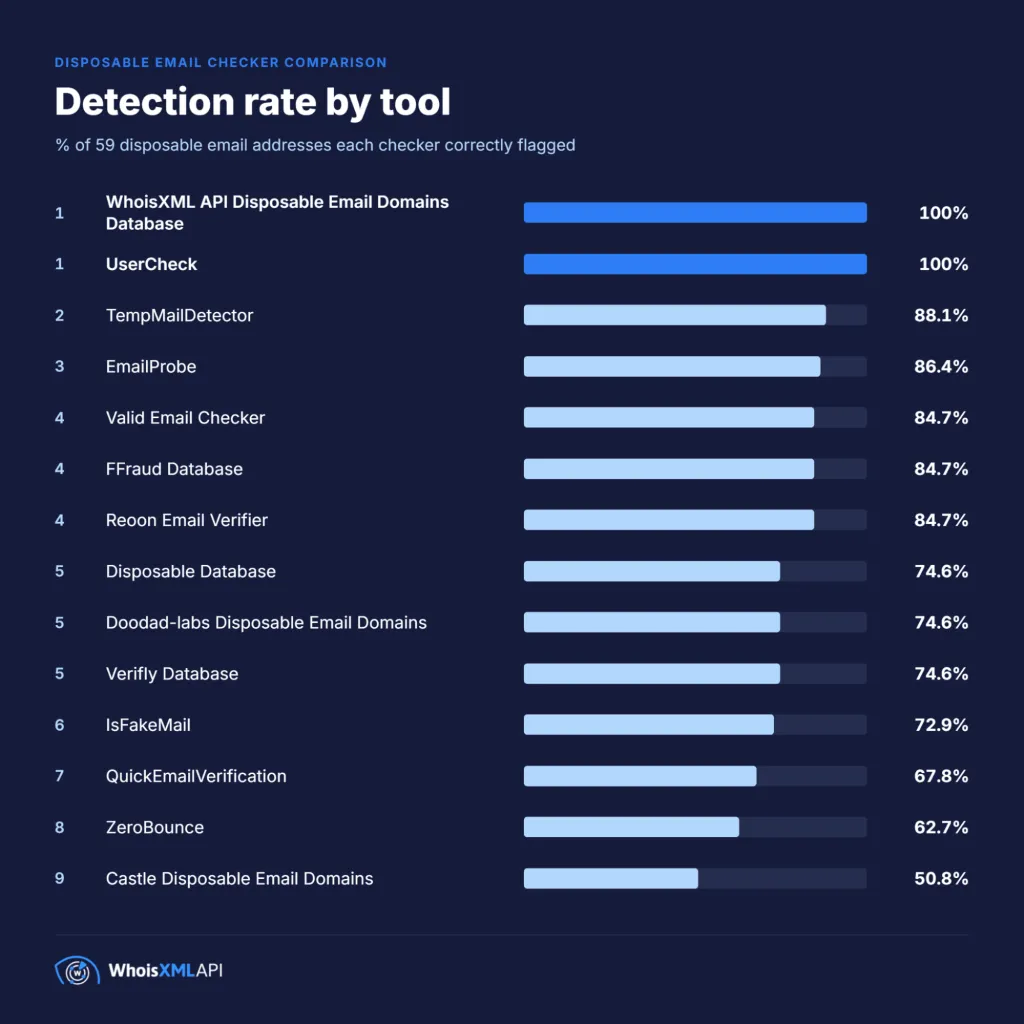
Valid Email Checker, FFraud Database, and Reoon Email Verifier tied at the fourth spot, detecting only 50 (84.7%) of the disposable emails in our test.
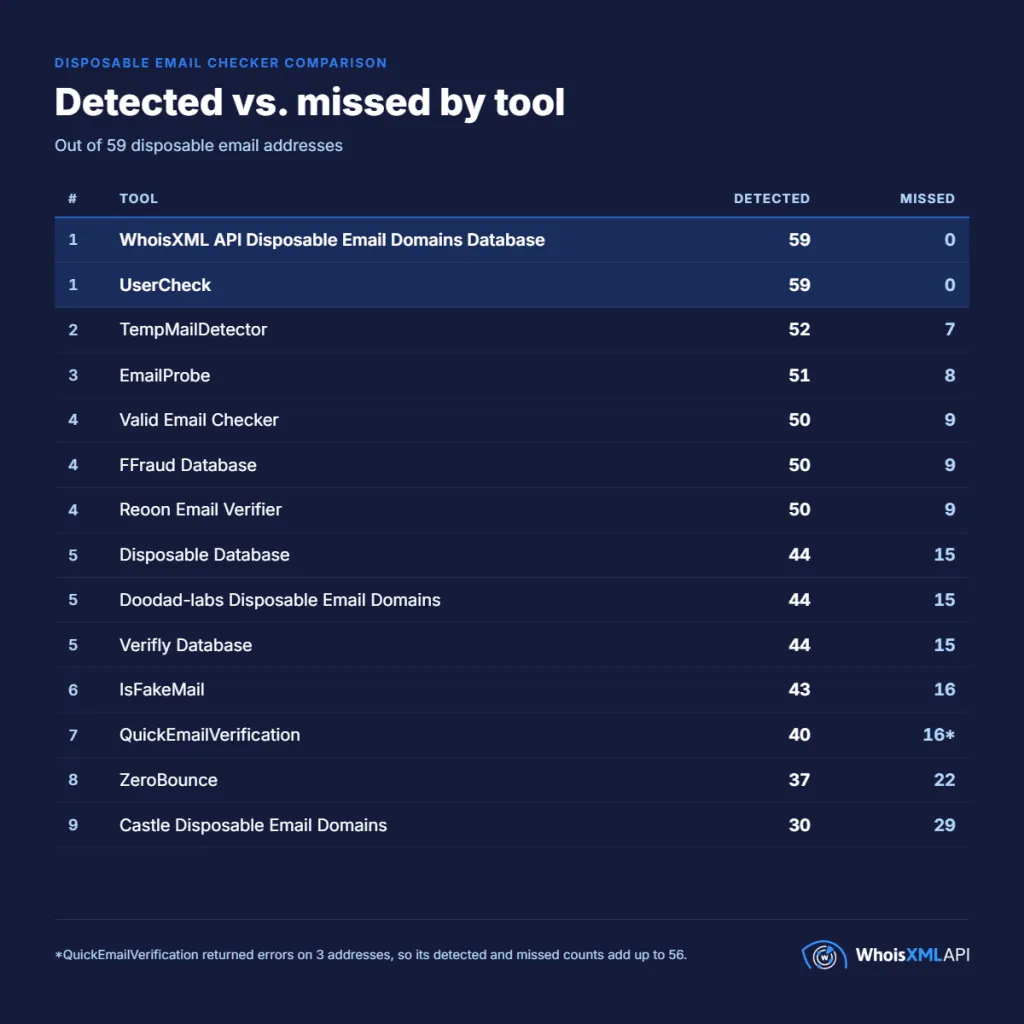
Disposable Database, Doodad-labs Disposable Email Domains, and Verifly Database had the same detection rate of 74.6%, or 44 out of 59 disposable emails. SignupScore (formerly IsFakeMail) detected 43 (72.9%), QuickEmailVerification flagged 40 (67.8%), ZeroBounce flagged 37 (62.7%), and Castle Disposable Email Domains detected only 30 (50.8%) disposable emails.
The table below shows the number of disposable email addresses each tool caught, compared to what they missed.
Smaller Providers Separate the Top Checkers From the Rest
All tools we tested caught the email addresses from Temp-Mail.org, Mail.tm, and YOPmail, and the other well-known services were nearly as easy. Castle Disposable Email Domains missed one Guerrilla Mail address, and ZeroBounce missed all three 10 Minute Mail addresses, but most others caught every address from well-known disposable email providers.
The real gaps were concentrated in a handful of lesser-known providers. Five of them accounted for 125 of the 170 total misses across all 14 tools, and addresses from two of them got past 11 of the 14 checkers at least once. Some of their domains don’t look like temporary email at all and read like ordinary business or app sites.
We tested 3 addresses from each of these five providers (15 total), and the chart below shows how many of those 15 each checker missed.
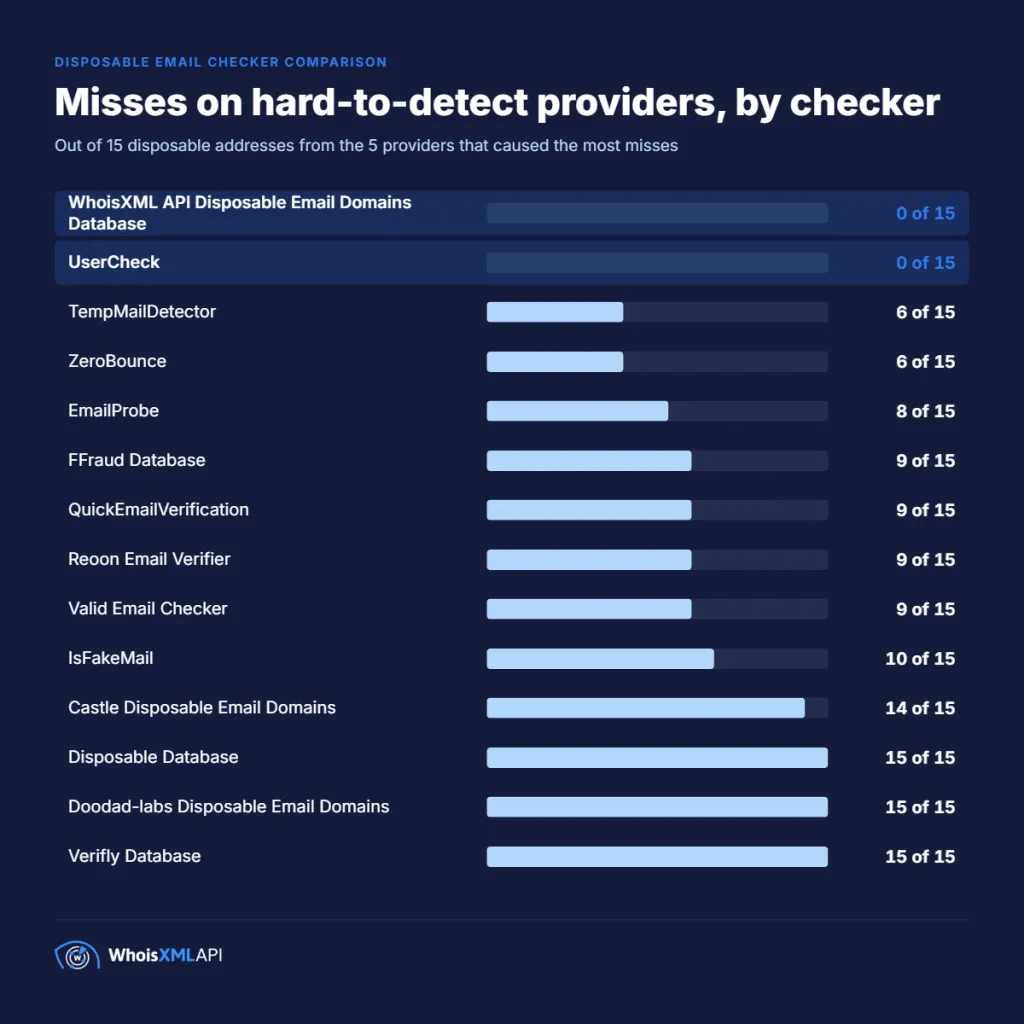
Only WhoisXML API Disposable Email Domains Database and UserCheck caught all 15. For seven of the checkers, the five providers account for every address they missed.
This is important to point out because it’s a coverage problem. A disposable email detector can only flag domains that are in its dataset. If a provider’s domains aren’t covered, signups from that provider get through, no matter how well the tool handles everything else.
False Positives Were Rare, With One Caveat
Six of the disposable email detectors flagged mail@example[.]com as disposable. Since that domain is reserved for documentation and examples, no legitimate user really signs up with it, so blocking that email at signup is arguably a feature.
However, one flag could cost you a real user, and this came from TempMailDetector, which marked a legitimate email address on a one-year-old .dev domain as disposable. Unlike the example[.]com email, this error could result in a blocked, legitimate user.
Conclusion
WhoisXML API Disposable Email Domains Database and UserCheck were the only checkers to catch every disposable address in our test with zero false positives. TempMailDetector, EmailProbe, Valid Email Checker, FFraud, and Reoon formed a second tier, catching 84.7% to 88.1%. Below that, you’re letting at least 1 in 4 fake signups through the door.
If you’re choosing a disposable email detector and are reading this for this reason, here are the takeaways from our experiment about what you should be looking for:
- Coverage: Most tools can detect Guerrilla Mail, but how about smaller providers? What set the top tools we tested apart from the rest was that they caught less obvious disposable email providers.
- Update frequency: Disposable providers rotate domains constantly, sometimes even daily, so a list that was great even a week ago may not be today. Choose a detector that has an up-to-date, frequently updated inventory of disposable domains.
- Low false positives: A burner email that goes undetected could mean that someone who may never become a paid customer is now abusing your free trial. However, a real user with a legitimate email that gets blocked because your tool incorrectly flagged it as disposable can actually cost more.
- A plan for the gray area: Not all email addresses are clearly disposable or clearly legitimate. Some tools that return scores might rate an email address 50%, and some tools flag privacy relays (e.g., Apple’s Hide My Email or DuckDuckGo Email Protection) and role-based shared addresses (e.g., support@). If you want to set your own thresholds and rules, choose a tool that returns these signals. If you want a quick decision at signup, a simple yes or no may be easier to work with.
It’s worth noting that this experiment only provides a snapshot. We tested 59 disposable addresses and 6 controls at a single point in time, while disposable email providers add new domains every day or week.
WhoisXML API Disposable Email Domains Database caught all disposable addresses in our test. Learn how it can keep fake signups out of your free trials.