VibeCheck Failed: Inside 1207 Ledger Branded Pages on Rapid Publishing Platforms test

WhoisXML API researchers have reviewed 30,001 hostnames containing the word Ledger and 23,495 saved screenshots. Of the 1,207 pages that visibly presented Ledger, 1,140 involved at least one familiar customer activity: downloading software, setting up a device, accessing an account, recovering a wallet, making a purchase, or contacting support.
Executive Summary
- WhoisXML API identified 1,207 webpages visibly presenting Ledger, out of 30,001 Ledger-related hostnames reviewed.
- Most pages mimicked normal Ledger customer journeys such as downloading software, setting up a device, signing in, restoring a wallet, buying hardware, or contacting support.
- Downloads and device setup were the most common themes, while some pages also requested sensitive information such as passwords, recovery phrases, private keys, or passphrases.
- The activity was highly reusable and concentrated on rapid-publishing platforms. Cloudflare Pages hosted 1,006 of the 1,207 Ledger-presenting pages, with repeated designs appearing across multiple hostnames.
- Many sites had already triggered provider action: more than 11,000 saved captures showed warnings or suspensions, although the data does not show how quickly providers responded.
- Bottom line: the report shows how Ledger impersonation is being produced and reused at scale by copying familiar customer flows and branding.
| 30,001 hostnames containing the word Ledger | 23,495 saved screenshot captures | 1,207 pages visibly presenting Ledger | 17 real Ledger domains (registrant-linked) |
What 1207 Screen Captures Showed
Ledger customers routinely download Ledger Live, set up devices, restore wallets, buy hardware, and contact support. The captured pages reused those same familiar situations.
Visual analysis identified 1,207 pages that presented Ledger through its name, Ledger Live, product imagery, wallet language, or a related customer flow. Of those, 1,140 matched at least one of six recognizable customer activities. Many combined several activities on the same page.
The review began with 30,001 distinct fully qualified domain names containing the literal string ledger. WhoisXML API preserved 23,495 screenshots and classified each one as page content, a provider intervention, a provider error, or another outcome. The screenshots showing page content were then reviewed for visible Ledger branding and customer activity.
That process also preserved the broader set: 57 wallet-related pages did not show enough evidence to confirm a Ledger identity, while 3,591 page-content screenshots were classified as unrelated or unresolved.
Six Customer Actions The Pages Promote
The 1,140 classified pages covered software downloads, device setup, account access, wallet recovery, product purchases, and customer support. A single page could include several of these stages, moving a visitor through multiple requests while keeping the same branding and visual context.
| Customer activity | Candidate hostnames | Saved captures | Ledger-presenting pages | Visible use |
| Download software | 11,208 | 9,065 | 885 | Ledger Live and operating-system downloads |
| Initialize a wallet | 6,654 | 5,124 | 682 | Device setup, PIN and recovery guidance |
| Enter credentials | 3,781 | 2,709 | 215 | Account access and sign-in controls |
| Connect or restore | 306 | 267 | 103 | Recovery material and wallet control |
| Purchase a device | 1,604 | 1,315 | 146 | Products, prices and checkout routes |
| Contact support | 2,300 | 1,688 | 136 | Phone, email and chat handoffs |
The categories overlap because one page can offer a download, setup instructions, account access, and support at the same time. Another 67 Ledger-presenting pages contained reference or informational content that did not fit neatly into any of the six activities.
1. Downloads Opened Most of the Flows
Downloads were the largest category. Eight hundred eighty-five pages visibly presented a Ledger download experience. Some offered a single Download Now button. Others reproduced the operating-system selection itself, offering Windows, macOS, Linux, iOS, and Android download options.


2. Setup Made Sensitive Requests Look Routine
Setup language appeared across 682 Ledger-presenting pages. The screenshots used familiar onboarding language such as start, initialize, connect, choose a PIN, and protect a recovery phrase. Some pages placed requests for device identifiers or passphrases inside that first-use context.


3. Account Access Stayed Inside the Brand Presentation
Account-access terms appeared in 3,781 candidate hostnames. Two hundred fifteen screenshots visibly presented Ledger account access. The pages included account identifiers, access PINs, and sign-in controls. One preserved screenshot placed email and password fields inside a Ledger affiliate presentation.


4. Recovery Flows Asked for Wallet Control
Connect-or-restore terms appeared in 306 candidate hostnames. 103 screenshots visibly presented a Ledger connection or recovery flow. These pages asked for, or directed users toward entering, recovery phrases, private keys, passphrases, and wallet backups.


5. Product Pages Created a Purchase Route
Commerce terms appeared in 1,604 candidate hostnames. One hundred forty-six screenshots visibly presented Ledger products or purchase flows, including product imagery, prices, color choices, Buy Now buttons, and shopping carts.


6. Support Shifted the Exchange to Phone Email or Chat
Support terms appeared in 2,300 candidate hostnames. 136 screenshots visibly presented Ledger support, often through phone numbers, email addresses, chat language, or supposed customer-service channels.


Reuse Was Visible in Screenshots and Project Names
The Ledger-presenting set was concentrated on rapid-publishing infrastructure. Cloudflare Pages hosted 1,006 of the 1,207 pages. The remaining captures appeared across Framer, Netlify, GitBook, Webflow, Vercel, Blogger, Umso, Firebase, GoDaddy Sites, GitHub Pages, WordPress.com, Bolt, Render, Shopify and unresolved infrastructure.
Exact file hashing showed that the 1,207 screenshots represented 1,056 distinct images. Seventy-six groups of repeated images covered 227 hostnames, and the largest group appeared across 16 FQDNs. Project names provided another visible sign of reuse, including at-ledger-downlaod[.]pages[.]dev, supoort-ledgerlivdekstp[.]pages[.]dev, conncet-start-ledger[.]pages[.]dev, walet-ledgerlive[.]pages[.]dev and welocome-ledgerstart[.]pages[.]dev.
One Cloudflare Pages family joined cry-ledger-live[.]pages[.]dev, ens-ledger-live[.]pages[.]dev and rn-ledger-live[.]pages[.]dev through the same screenshot and the same misspelled product label, “leadgre-live.” The surrounding page still presented a polished promise of “Secure & Smooth Crypto Access.”
The repeated images, recycled customer flows, and project-name errors point to a rapid, reusable production pattern. In this report, vibe coded is simply a label for that observed pattern. It does not identify a particular model, prompt, repository, or author.
The First Party Ledger Footprint Provided the Comparison
Managed hosting is also part of Ledger’s legitimate web presence. WhoisXML API researchers therefore built a 17-apex comparison set associated with Ledger using exact registrant-email searches. Sixteen current WHOIS records named Ledger as the registrant organization, 16 used Gandi as registrar and 15 retained one of the searched email addresses.
DNS and certificate observations identified four first-party hostnames that Ledger had deliberately delegated to managed platforms:
| Confirmed Ledger FQDN | Platform | DNS evidence | TLS evidence |
| brand[.]ledger[.]com | Webflow | CNAME to cdn[.]webflow[.]com | Leaf certificate names the FQDN |
| enterprise[.]ledger[.]com | Webflow | CNAME to cdn[.]webflow[.]com | Leaf certificate names the FQDN |
| developers[.]ledger[.]com | Vercel | CNAME to a vercel-dns-016[.]com target | Leaf certificate names the FQDN |
| shop[.]ledger[.]com | Vercel | CNAME to a vercel-dns-016[.]com target | Leaf certificate names the FQDN |
Each relationship connected a Ledger-linked parent domain, deliberate DNS delegation, and a certificate naming the exact hostname. None of the 30,001 candidate hostnames matched or fell under any of the 17 linked apex domains.
Among the 30,001 candidates, 23,023 appeared beneath 11 recognizable builder and rapid-publishing domains. Cloudflare Pages accounted for 16,765 and Webflow for 4,494. The remaining 1,764 crossed Framer, Vercel, Firebase, Netlify, GitHub Pages, Umso and Bolt infrastructure.
Warning and Suspension Screens Were Already Common
Provider notices appeared in 11,016 saved screenshots. The clearest comparisons came from screenshots where the hosting service itself displayed a warning or suspension notice.
| Provider | Visible provider action | All saved platform captures | Share showing action | Observation-to-capture interval |
| Cloudflare | 9,637 suspected-phishing warnings | 14,446 | 66.71% | 352-day median across 9,227 dated cases |
| GitBook | 626 spam suspensions | 1,672 | 37.44% | 732-day median across 607 dated cases |
| Vercel | 1 disabled deployment | 332 | One observed case | 1,179 days in that case |
Cloudflare’s warning replaced the underlying page in roughly two-thirds of saved Cloudflare Pages captures. GitBook’s suspension screen appeared in more than one-third of its saved captures. The broader OCR count contained 9,642 Cloudflare suspected-phishing screens; the narrower provider-comparison cohort contained 9,637.
The elapsed-day figures compare two specific events: WhoisXML API’s first passive observation of a hostname and the later screenshot capture. For the middle half of dated Cloudflare warning cases, that gap was 329 to 368 days. For GitBook, it was 704 to 789 days. These figures measure only the gap between first observation and screenshot capture; they do not establish when a page was published, how long it was exposed, when a provider intervened, or how quickly it was taken down.
The Complete Visual Census Runs for Nine and a Half Seconds
The visual census contains every hostname-level screenshot in the Ledger-presenting set: 1,207 screenshots represented by 1,056 distinct images.
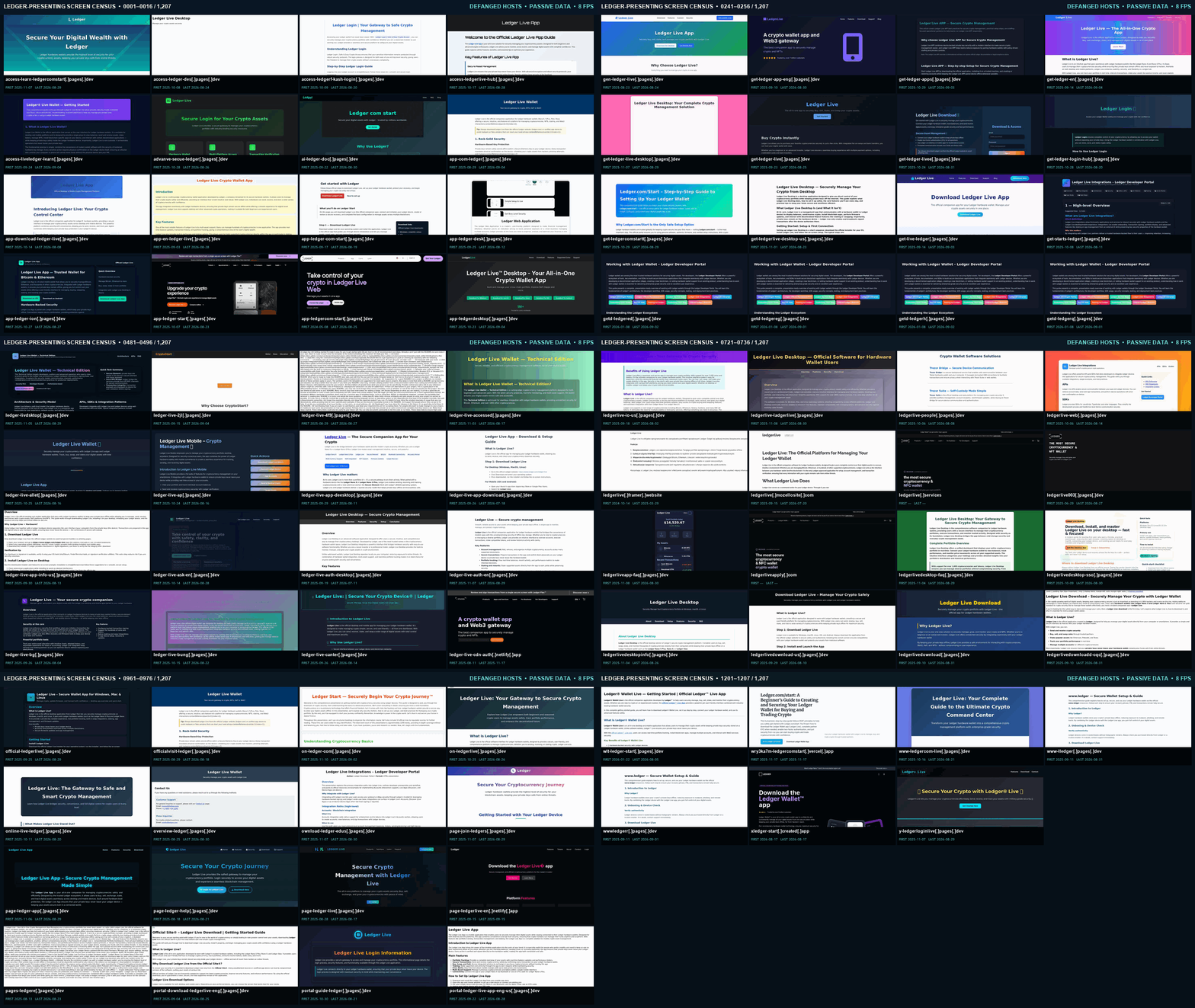
Each frame contains 16 screenshots with defanged hostnames and WhoisXML API Subdomains observation dates. At eight frames per second, the census runs for 9.5 seconds. The film shows both the scale and variety of the captured set, while the searchable evidence atlas keeps each individual record available for inspection.
The page designs, hosting platforms, and writing quality varied, but the same customer activities kept returning. Software downloads, device setup, account access, wallet recovery, product purchases, and support repeatedly provided a familiar context for asking a Ledger customer to take action.
Method and Interpretation Note
Counts are current through September 20, 2026. WhoisXML API combined four evidence layers: a registrant-linked comparison set, a census of hostnames containing the literal string ledger, remotely preserved screenshots, and offline visual analysis.
The candidate rule required the literal string ledger somewhere in the FQDN. The rule excludes misspellings without that string, homoglyphs, brand-free lures, path-only references, redirects, compromised websites and pages that used Ledger imagery without placing the brand in the hostname. The 30,001 names therefore represent a reproducible slice of the broader possible impersonation surface.
The 23,495 saved captures separated into 4,855 page-content screens, 11,016 provider interventions, 434 provider errors and 7,190 other outcomes. Another 6,506 candidate hostnames had no saved screenshot. Among the page-content screens, 1,207 visibly presented Ledger, 57 showed a wallet flow without enough visible evidence to establish Ledger identity and 3,591 were unrelated or unresolved.
First-seen and last-seen dates are the bounds of WhoisXML API Subdomains observations. They are not creation, publication, continuous-uptime, or takedown dates. All candidate-page findings came from remotely captured images and preserved WhoisXML API data. The review did not require visiting candidate pages or running code found on them.
The Evidence Package and the IASC
The supporting evidence package preserves:
- all 30,001 candidate hostnames;
- all 23,495 screenshot records and 6,506 names without a saved screenshot;
- all 4,855 page-content findings;
- the 17-apex registrant-linked comparison set;
- the 1,207-page visual census; and
- the source and reconciliation records behind the published totals.
To get access to this evidence atlas to inspect the captured cases or request the supporting dataset, reach out to the Internet Abuse Signal Collective (IASC) representatives. The IASC also accepts brands, abuse patterns and provider questions for evidence-led investigation.